Let's see how Credit Card Simulator helps Aisha towards her Goals
This layout improves Aisha’s experience by guiding her attention step by step, reduces cognitive overload. First helping her understand key credit details, then offering the simulator as a natural next step to explore and learn.

Viewing her current score and score change, reinforces awareness of her credit health.
This layout improves Aisha’s experience by guiding her attention step by step, reduces cognitive overload. First helping her understand key credit details, then offering the simulator as a natural next step to explore and learn.
Pay pending credit card bills, turning insights into immediate action.
This layout improves Aisha’s experience by guiding her attention step by step, reduces cognitive overload. First helping her understand key credit details, then offering the simulator as a natural next step to explore and learn.
Explore secured credit card or loan options, guiding her toward next steps for building or improving credit.
Aisha opens up the Olyv app to casually check her credit insight.
After that, Aisha clicks on Check Score button leading to first fold of Olyv Plus page.
She goes through all the credit insights and scroll down to second fold to explore more.
Aisha sees the simulator feature and clicks on it to explore.
This layout improves Aisha’s experience by guiding her attention step by step, reduces cognitive overload.
This help her understand key
credit details, then offering the simulator as a natural next step to explore and learn.
After clicking, she landed on the page where she can see all the scenarios. She choose a scenario "Pay off all credit card".
By viewing all scenarios upfront, she easily understands her options and feels in control of her learning journey.
Listing down all the credit card makes the process intuitive and personalized.
Score appears on the result screen, where user is given the following information :
Quick Actions
Buy Gold
Credit Score
Prime
New
Profile
Referral
Spin to Win
Verify your Location
Verify your Address to proceed

800
Olyv Plus
Membership
Build Your Credit Score
1 Free Refresh
Check Score
Build Credit Score
View all
Resume Loan Application
Olyv Plus
Manage Credit Cards
View all
XXXX 8976
ICICI Bank

₹60,000
Avail. Credit Limit
₹0
outstanding
No dues pending
View
XXXX 8976
HDFC Bank

₹60,000
Avail. Credit Limit
₹10,000
outstanding
Due on 22nd Apr
View
XXXX 8976
HDFC Bank
₹60,000
Avail. Credit Limit
₹10,000
outstanding
Overdue by 2 days
View
Pending Actions
View all
Manage Loans
Outstanding: ₹50,000
Gold Loan

Outstanding: ₹50,000
Secured Credit Card


Outstanding: ₹50,000
Auto Loan

Outstanding: ₹50,000
Home Loan

Outstanding: ₹50,000
Education Loan

Outstanding: ₹50,000
Equipment Loan

Outstanding: ₹50,000
Other loan

Outstanding: ₹50,000
Personal loan

Outstanding: ₹50,000
Business loan


Secured
Card

Gold
Card
Auto
Loan
Equipment
Loan
Resume Loan application - ₹18,000
Business Loan

Resume
Hey, Gokul J
Welcome back
G
A
Get Loans upto
₹5,00,000
We have a new Loan Offer for you!

Apply Now

Credit Score

800
10

Score History
Manage your Plus Membership
Get Full Report
Full Credit Report
Powered by


Your Loans
₹5,00,000
Credit Cards
03
Overdue
₹47,600
Check Credit Insights
Credit Cards
Total Cards
4

Loans
Active Accounts
4

Payments
On-time Payments
100%

Enquiry
Active Accounts
4
Age
Oldest Account
4
Credit Limit
Limit Used
4
Protect Your Credit Score
New Enquiry
New Loan or Credit Card
Personal Details

Fraud Prevention
Dispute Management

Improve Credit Score
Old Score
New Score


800
Increase your Score from 810 to 850
Document Garage

All Your Loan Documents in one place, safe and secure!



+5
Loans
via Olyv Partners
Secured Cards via Olyv Partners


+2

Personalised Offers for You
Get detailed insights!
of your Credit Score

4 Crore+
Indians Trust
Olyv


4 Crore+
Indians Trust
Olyv
Get Full Report

Your Loans
₹5,00,000
Credit Cards
03
Overdue
₹47,600
Check Credit Insights
Credit Cards
Total Cards
4
Loans
Active Accounts
4
Payments
On-time Payments
100%
Enquiry
Active Accounts
4
Age
Oldest Account
4
Credit Limit
Limit Used
4
Protect Your Credit Score

Dispute Management
Loans
Credit Cards

Report an Error
Improve Credit Score
Old Score
New Score
800
Increase your Score from 810 to 850
Document Garage
All Your Loan Documents in one place, safe and secure!
+5
Loans
via Olyv Partners
Secured Cards via Olyv Partners
+2
Personalised Offers for You
800
10
Get detailed insights!
of your Credit Score
Score History
Manage your Plus Membership
Credit Score
800
Past Simulations
Miss Loan EMI payment
823
809
Enquire for a Loan or Card
823
829
Predict your Score
Close Oldest Credit Card
Clear Credit Card payments
Get
New Loan
Pay off all your Loan Amount
Miss all Loan EMI Payments
Get Credit Card
Enquire for a Loan/C. Card
Pay Off Credit Card debt
Simulator
Swiggy HDFC Credit Card
Due: 12 Jun, 2025
₹1,849
Pending

Flipkart Axis Credit Card
Due: 12 Jun, 2025
₹1,899
Pending
Amazon pay ICICI Credit Card
Due: 12 Jun, 2025
₹1,789
Pending
Amazon pay ICICI Credit Card
Due: 12 Jun, 2025
₹1,789
Pending
Select All
Pay Off Credit Card
Predict My Score
800
Past Simulations
Miss Loan EMI payment
823
809
Enquire for a Loan or Card
823
829
Predict your Score
Close Oldest Credit Card
Clear Credit Card payments
Get
New Loan
Pay off all your Loan Amount
Miss all Loan EMI Payments
Get Credit Card
Enquire for a Loan/C. Card
Pay Off Credit Card debt
Simulator
Swiggy HDFC Credit Card
Due: 12 Jun, 2025
₹1,849
Pending
Flipkart Axis Credit Card
Due: 12 Jun, 2025
₹1,899
Pending
Amazon pay ICICI Credit Card
Due: 12 Jun, 2025
₹1,789
Pending
Amazon pay ICICI Credit Card
Due: 12 Jun, 2025
₹1,789
Pending
Select All
Pay Off Credit Card
Predict My Score
A bottom sheet opens up once after she clicks on the scenario. she can choose to pay off any number of credit card by selecting the check box. Aisha then clicks on predict my score button.


Changes in the score

User can pay a pending cc bill giving a heads up to improve the score
Scroll Down
Let's see how Credit Card Simulator helps Aisha towards her Goals



User Journey Starts
User Journey Ends
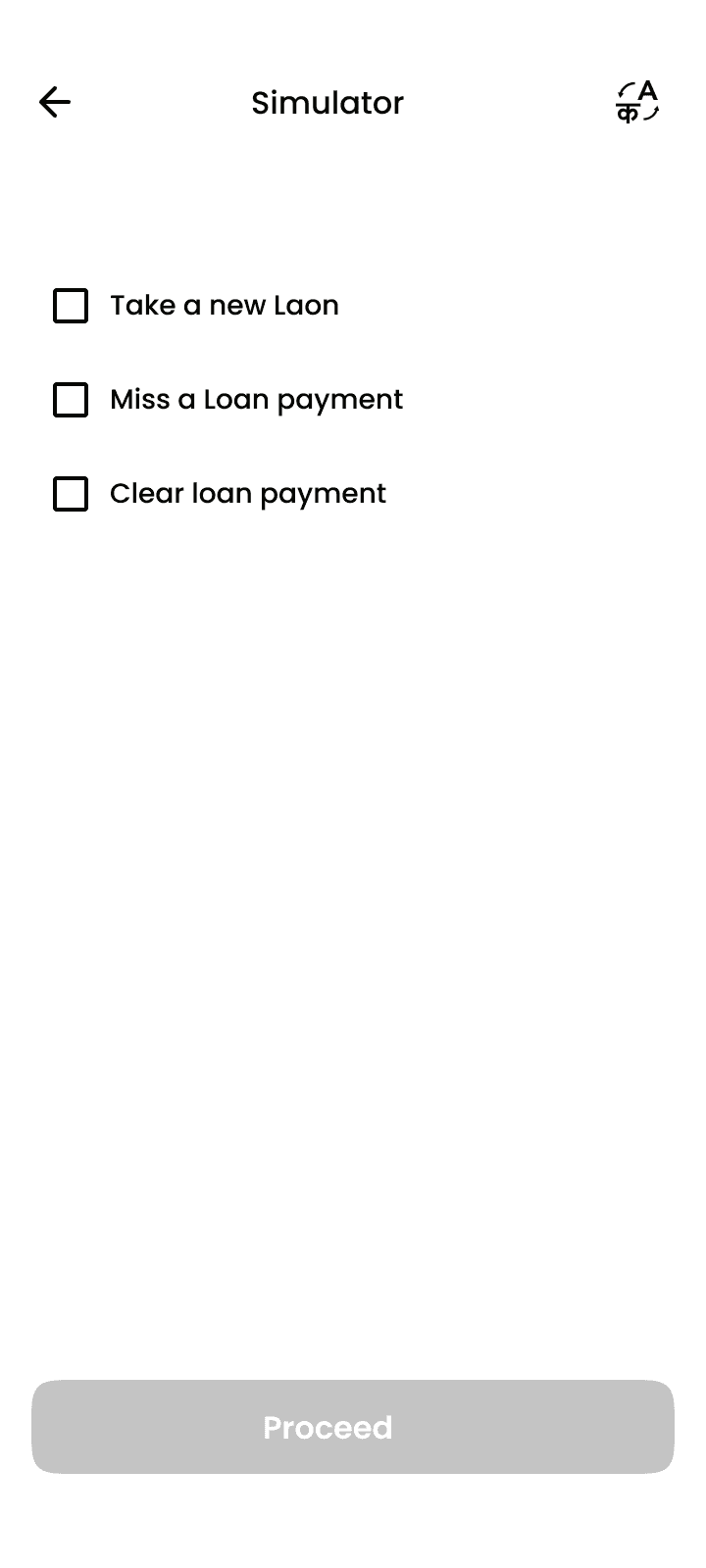
User can choose actions or scenarios based on whether they fall under Loans or Credit Cards.
User selects Loan and sees all the options that fall under the Loan category.
User selects the “Take a New Loan” option from the list.
User selects the loan type and enters the corresponding amount. They can also add an additional scenario before running the simulation.
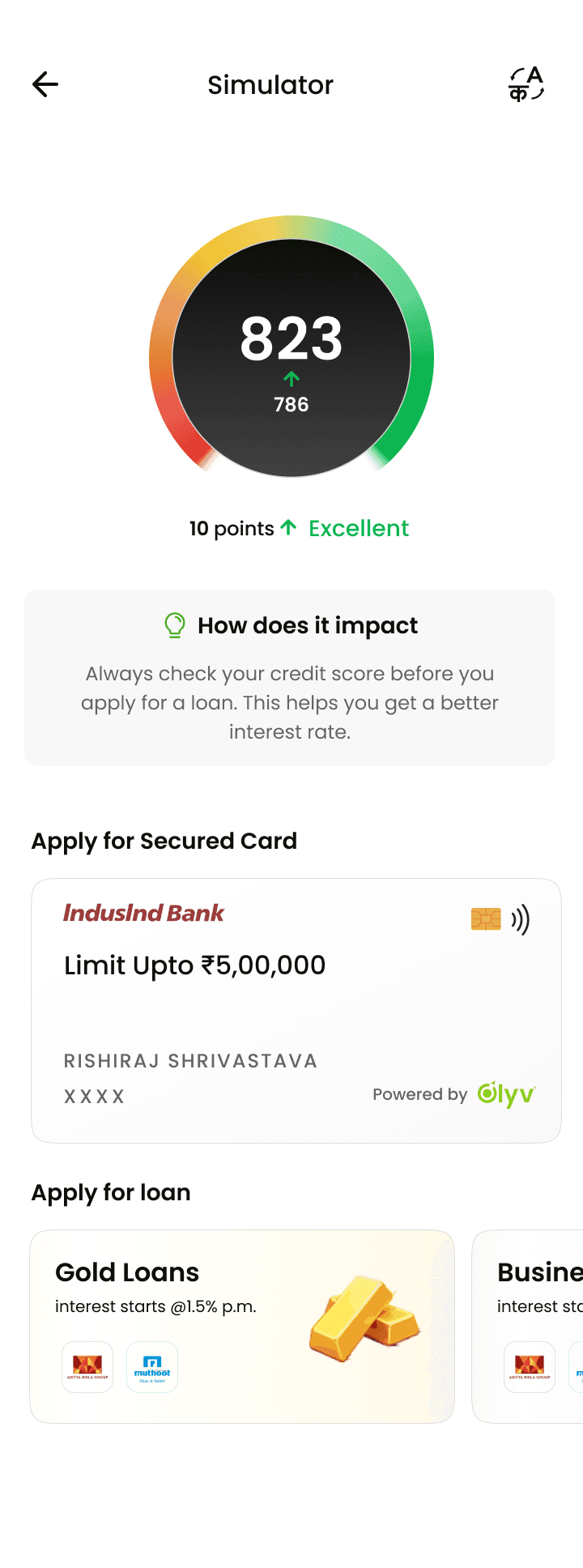
After clicking Simulate, the user sees the final result: score changes, steps to improve their score, and recommended products or offers that can help boost it.

Option 1: Loan / Credit Card categorisation in the Credit Score Simulator
Users are goal-oriented, not category-oriented. When a user opens a credit score
simulator, their internal dialogue is:
✅“I want to see how taking a new loan affects my score”
and not
❌“This action falls under the Loan category”.
These labels feel broad and abstract.
Users might not instantly know why they should pick one over the other.
Categorization feels like internal sorting rather than solving a user need.
How and Why did I Finalize this User Flow?
On initial ideation and wireframing stage we had three different user flows, these are ones :
User Journey Starts
The user can select any scenario they prefer.
After selecting the scenario, user can specify if whether for loan or credit card, eg. Take a new loan.
Specify the loan type and the amount they need. If the user wants to add another scenario, they can click “Add New Category”, which will take them back to the scenario selection page.
Once the user returns to the scenario selection page, they can choose another scenario.
Again user can specify the scenario whether for loan or credit card, eg. Miss a credit card bill
Option 2 : Scenario based Credit Score Simulator
The next option was to make the user flow scenario-based, which was:


User Journey Ends
After selecting all the required scenarios, the user can click the “Simulate” button to proceed to the final page.
On the final page, the user can view the change in their credit score, along with products or offers that can help them improve it.
The user can choose how many days they expect to miss the payment, eg. 30 days.

Too many actions, choices, or unclear next steps force users to rethink every move, leading them to abandon the process.
When something feels complicated, users start doubting the product’s reliability and may choose not to continue.
This User flow is long and confusing and user might find it hard to adapt.
User Journey Starts
The user can select any scenario they prefer.
After selecting the scenario, user can specify if whether for loan or credit card, eg. Take a new loan.
Specify the loan type and the amount they need. If the user wants to add another scenario, they can click “Add New Category”, which will take them back to the scenario selection page.
Once the user returns to the scenario selection page, they can choose another scenario.
Again user can specify the scenario whether for loan or credit card, eg. Miss a credit card bill
Option 3 : Scenario based Credit Score Simulator
Through more feedback and discussion from fellow product designers and product managers, we thought of giving the UI a different structure:
User Journey Ends
After selecting all the required scenarios, the user can click the “Simulate” button to proceed to the final page.
The user can choose how many days they expect to miss the payment, eg. 30 days.


As users continue to add scenarios, the page grows in length and loses its scannability, introducing unnecessary complexity and making it harder for users to process information efficiently.
Simple and intuitive flow that enables even less-informed users to predict their credit score with ease.
Instant results after the first simulation, triggering curiosity and motivating users to explore the feature further.
Controlled and guided addition of scenarios, preventing overwhelm and helping users experiment with different actions or factors in a structured way.
These inadequacies highlighted the need for a better approach, ultimately leading us to design the current flow for the following reasons:
✅
Before I even started designing the Simulation Result Screen, I had a feeling that the biggest challenge wouldn’t be showing the score, it would be helping users understand what it really means for their financial health. I kept that thought in the back of my mind as I moved ahead.
My first step was to list all the information a user would expect after running a simulation. Three things stood out clearly:
This became the base structure of the screen. To keep the visual language familiar and intuitive, I collected all UI components already used in the app. I wanted users to feel like they were still within the same system, without learning new patterns or interacting with unfamiliar elements.

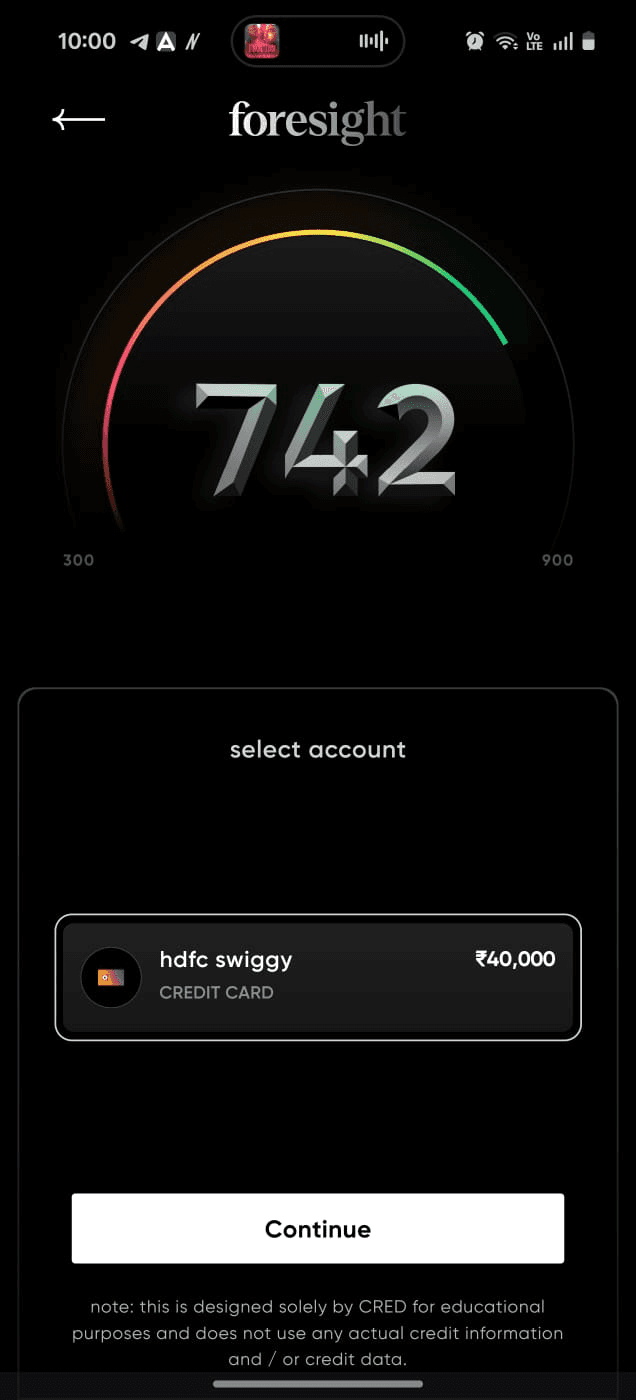
To find out, I studied competitors like CRED, GPay, Good Score, and Bajaj Finserv. Almost all of them didn’t stop at just showing a score. They went a step further, they gave personalized advice or actionable tips, helping users understand why their score changed and what they can do next. That was the missing puzzle piece.
At one point, I explored adding an “Add Another Simulation” button so users could test multiple scenarios in one flow. It looked exciting on paper, but testing it with our target audience told a different story. It made the journey confusing and heavy. So we returned to our guiding principle, simplicity, and decided to allow only one simulation at a time.
With the content finalised, I focused on how to communicate results emotionally and meaningfully. I refined the UX writing and UI layout to make the score change the hero of the screen.
And finally, to make the result instantly understandable, I used color-coded feedback:
🟢 Green when the user’s action increases their score, and
🔴 Red when the score drops
This helped users connect their action with the impact in a single glance — no explanation required.

The Story Behind Designing the Simulation Result Screen
next iteration…
Finally I decided on the structure…


rather than a static credit score dial, as it gamifies the experience slightly without losing seriousness, helping users stay engaged with their financial health journey.
I imagined score reveal through an animated dial…



CRED
✅ Total credit score if they choose to do this action
✅ How much the score changed?
✅ Product recommendations that could improve their credit health.
View more…
⏭️Coming up next, Use cases & the Design Process
"One wrong move can impact the credit score you’ve been building since your very first credit card or loan"
Aisha, a 26-year-old professional, just got her first credit card. She’s heard of terms like credit limit, utilization ratio, and interest-free period, but doesn’t fully understand how they impact her credit score or financial health.
Meet Aisha!
🎯
Her goals are simple:
However, she unknowingly uses 80–90% of her credit limit and assumes that paying on time is enough. The real issue is that she isn’t aware that credit utilization is a key parameter affecting her credit score.
It turns complex credit concepts into clear insights, empowering users to build healthier credit scores, use credit cards smarter, and gain confidence in their financial decisions.
This knowledge gap of understanding credit health is solved by credit card simulator.
By helping users visualize and experiment with different spending and repayment scenarios safely, the simulator lets them see how changes in spending, payments, or utilization directly impact their credit score. This interactive feedback loop keeps users engaged as they experiment with scenarios, encourages them to return to track progress over time, and builds trust in the platform’s financial guidance, ultimately driving higher user engagement, retention, and subscription conversions to Olyv plus.
Use her credit card smartly
Build a good credit score for future loans
Avoid getting into debt
Aisha's Expectations
“Credit score will bounce back quickly.”
Aisha's Expectations
“I can use as much of my credit limit as I want, as long as I pay on time.”
The Reality
Exceeding the suggested usage limit signals high financial risk, score drops even if payments are on time.
The Reality
It can take months of consistent behaviour to recover lost points.
But what if you could anticipate those changes before they happen?